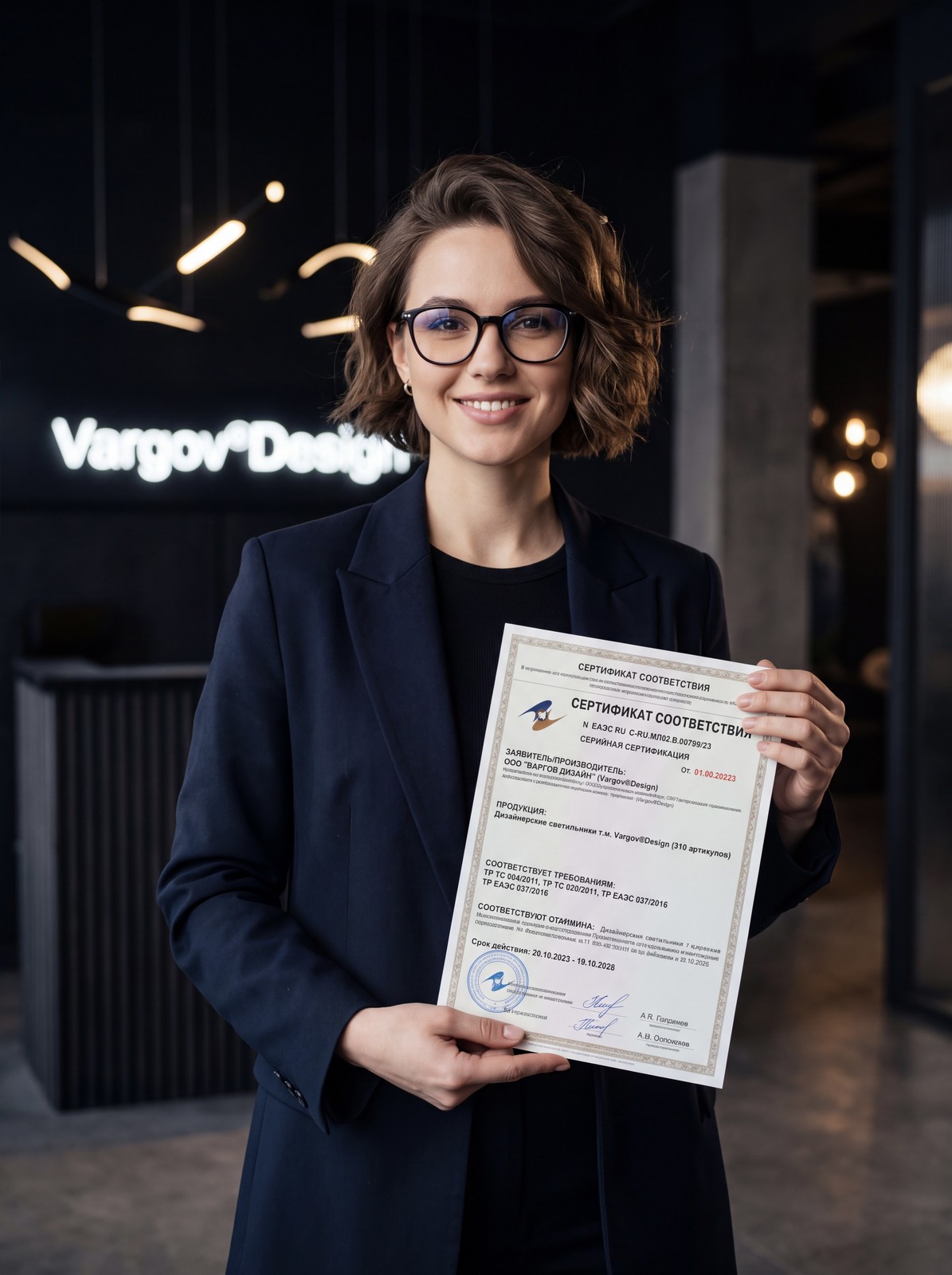
Serial certification: what stands behind it and what it gives a project
Vargov®Design products have passed serial certification under the requirements of the Eurasian Economic Union. For a buyer that is one line. For an architect, a designer and a tender department it is a set of verifiable documents, without which a bespoke piece never reaches the specification.
It is easy to write it in one line: “we are certified”. But the line alone means nothing — certificates differ a great deal, and the difference decides whether a composition enters a project or is struck out at approval stage. So here is what was actually done.
A batch and a series are not the same thing
Certification can be arranged in different ways. The simplest is a batch: a particular shipment arrives, it is tested, and a document is issued for those very items. When the batch is gone, so is the paper.
Serial certification works differently. It covers not the boxes but the production itself: everything made and yet to be made while the certificate is valid. The scheme is named accordingly — 1s, serial production. Samples are not enough to obtain it: the certification body inspects the production itself, to see whether it can repeat the result. That inspection is recorded in a separate document, the production analysis report.
This is why tenders ask for a serial certificate and almost never for a batch one.
What exactly is certified
Two certificates of conformity to the technical regulations of the Customs Union, issued on 7 and 8 September 2026 for five years. Together they cover 310 lighting composition codes — nine of them are in both certificates.
The first covers 53 codes under two regulations at once: TR CU 004/2011 “On the safety of low-voltage equipment” and TR CU 020/2011 “Electromagnetic compatibility of technical devices”. The second covers 266 codes under the low-voltage regulation.
Two declarations of conformity to TR EAEU 037/2016 — on the restriction of hazardous substances in electrical products — are registered separately. These are the requirements known worldwide as RoHS: they check composition, not operating safety. A certificate does not replace that check, and the reverse is equally true — two different documents about different things.
What was actually tested
Behind the words “passed the tests” stand specific standards. The scope covers eight GOST standards, and three are worth naming: they answer the questions projects ask most often.
GOST IEC 60598-1 — general requirements for luminaires: insulation, heating, mounting, protection against electric shock. GOST IEC 62471 — photobiological safety: whether the radiation harms eyes and skin in normal use. A non-obvious question, and an essential one for public spaces. GOST CISPR 15 — radio disturbance limits: whether the luminaire will interfere with other equipment in the building.
The other five cover electromagnetic compatibility, harmonic currents and voltage fluctuations. The dull part, on which it depends whether the composition will live peacefully with the dimmers, lifts and low-current systems of the site.
The body and the laboratory are different parties
A subtlety known in tender departments and almost nowhere else: the certificate is issued by a certification body, while the testing is done by an independent laboratory. These are different organisations with different accreditations, and documentation asks for both.
Our body is Test-St. Petersburg LLC, accreditation ROSS RU.0001.10SP28. The testing was carried out by the EvrazesTest joint testing centre, accreditation ROSS RU.0001.10TR01. The test reports have numbers and dates and are part of the document pack.
How to check rather than believe
This is where the point of the whole exercise lies. A certificate is not a picture on a website but a record in a state register. Every document has a registration number that opens the record in the register of the Russian Federal Accreditation Service: who issued it, to whom, for what, until when, and whether it is valid or suspended.
The full registration numbers are published on the certification page precisely for that — so that anyone can check them without asking us. Scanned forms are not published: they carry data that has no place in open access. The full pack — certificates, annexes listing the codes, declarations and test reports — is provided on request to architects, designers and tender departments.
Why bespoke lighting needs this
There is a persistent belief that a bespoke object and a verifiable document belong to different worlds. That one-off work by definition has no papers, and serial work by definition has no character.
It is a convenient misconception, and it gets in the way. A composition assembled for a particular ceiling hangs above people, heats up and connects to the building's electrical system just like any other fixture, and must be just as safe. The difference between “beautiful” and “may be installed in a public space” is exactly this pack of documents.
For us serial certification is not a marketing line but the next step in growing up: authored design should be not only expressive but fully ready for professional projects. Details, full numbers and validity dates are on the certification page: https://vargov.ru/en/certification
Dialogue
Let's talk about your project
The conversation goes both ways — tell us about your task and we will reply personally.