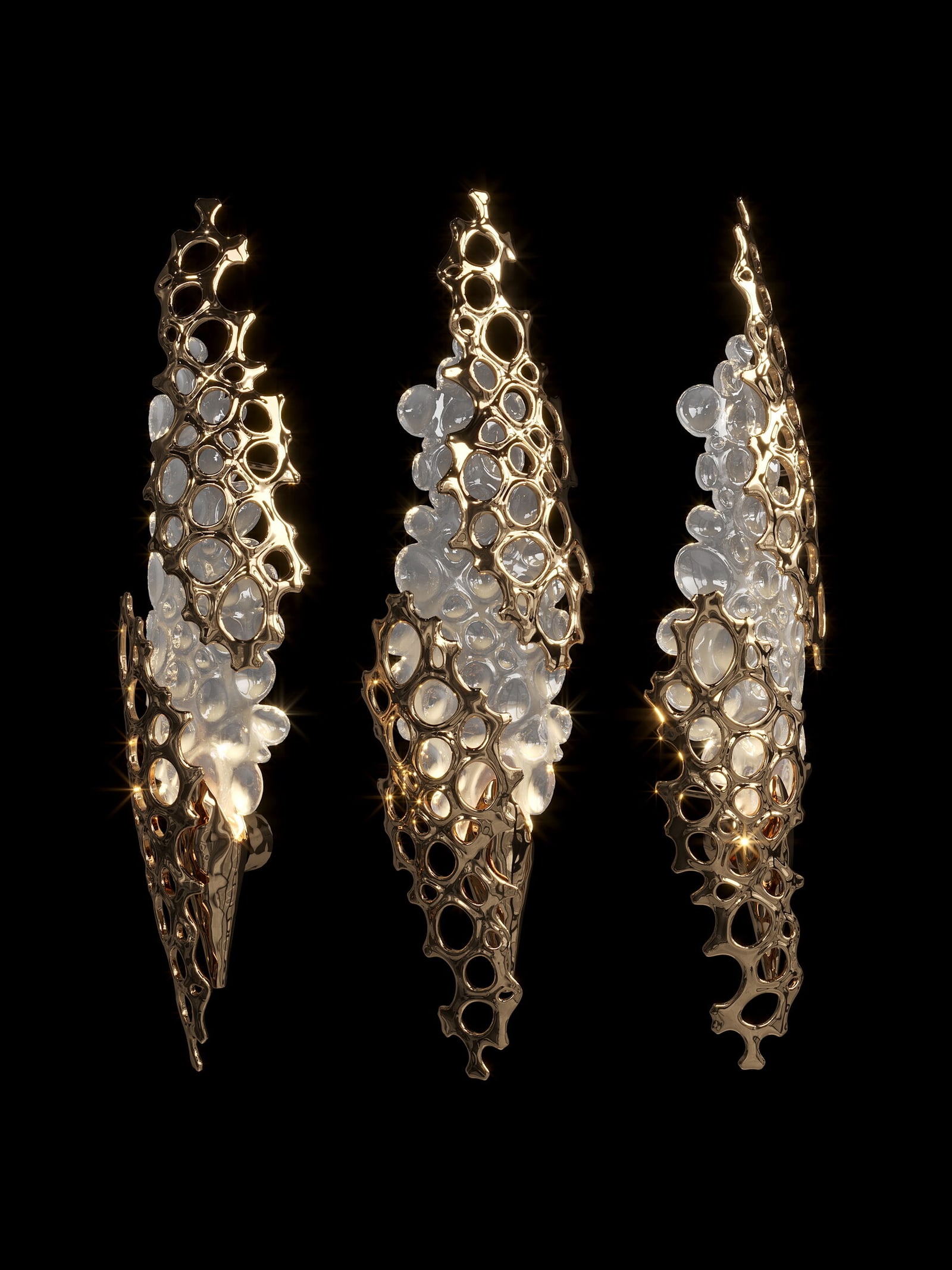
Russian Lighting Design: Where It Comes From and What It Looks Like Today
Italian glass and the Scandinavian lamp are known to everyone. The Russian tradition of light is reduced to the chandelier — yet it grows from three roots no one else has together: art glass, sculpture, engineering.
Ask a design-literate person to name a lighting tradition and two answers come first. Italy — Murano glass, the great post-war houses, light as a piece of furniture. Scandinavia — the lamp as an instrument of well-being, softness against a long winter, form pared back until only function remains. Both are real traditions with real histories. Russian lighting design is rarely named alongside them, and when it is, it is usually reduced to one image: the palace chandelier.
That image is not wrong. It is incomplete, and the missing half is the interesting one.
Three roots
Contemporary Russian lighting design grows from three older practices that rarely appear together elsewhere.
The first is art glass. Russia has made glass on an industrial scale since the eighteenth century — the Gus-Khrustalny works were founded in 1756, the Imperial Glass Factory in St Petersburg in 1777 — and, unusually, the craft never split cleanly into “tableware” and “art”. The same workshops that produced everyday objects produced sculptural ones, and the sculptural side was taught in academies rather than passed down as a trade secret. The result is a generation of designers for whom glass is a modelling material first and a light source second: something to be shaped, textured and coloured before anyone asks where the bulb goes.
The second root is the sculptural tradition. Russian applied art has always leaned monumental. The avant-garde of the 1920s treated the object as a spatial event rather than a household item, and that instinct survived the decades that followed in stage design, public art and architecture. A Russian lighting composition tends to be conceived as a form that happens to be illuminated, not as a fixture that happens to be attractive.
The third root is the engineering school. Soviet technical education produced designers who are comfortable with load, suspension, thermal behaviour and custom fabrication — the unglamorous questions that decide whether a five-metre installation can actually hang above a hotel atrium. When those skills sit inside a design studio rather than being outsourced, the studio can promise things a purely aesthetic practice cannot: that a composition will be drawn for a specific ceiling, calculated for it and installed by people who understand both.
How it differs
Set against the Italian tradition, Russian lighting design is less about the type and more about the composition. Italian houses perfected the pendant, the floor lamp, the sconce — recognisable products that live in catalogues and are bought by the piece. Russian studios more often work in series and installations: a family of elements arranged for a particular volume, where the drawing is done once for one interior and the individual element is subordinate to the whole.
Set against Scandinavia, it is unapologetically expressive. Nordic design makes light disappear into comfort. The Russian approach makes light visible — as a cascade, a ribbon, a suspended field of glass — and treats the fixture as the room’s centre of gravity rather than its background.
None of this makes one tradition better than another. It does mean that a client who wants an object to be looked at, not just lit by, will find a different answer here.
Where Vargov®Design stands
Vargov®Design is one of the studios that made this tradition legible abroad. The brand was founded and is led by designer Anton Vargov, and its catalogue today holds 605 compositions in four families — light compositions, decorative compositions, floor and table objects, and sculptural decor — each carrying an LC article code and each made to order for a specific interior at the brand’s own production.
The recognition has come from the juries that shape the international conversation. In 2023 Anton Vargov was named Product Designer of the Year at the NY Product Design Awards; the same year brought a Platinum Winner at The London Design Awards, a Platinum Winner and a Gold Winner at the International Architecture & Design Awards (ADC), and Winner titles at the European Product Design Award, BLT Built Design Awards and the SIT Furniture Design Award. In 2026 the composition “Oceanic Illumination” took Gold Winner at the MUSE Design Awards. At home, the brand received the special prize of the Russian Lighting Design competition at Interlight in 2022 and showed its first own stand at Interlight Moscow in October 2025. The brand’s 3D configurator was an Awwwards Nominee in 2026 — a nomination, not a win, and worth naming precisely for that reason: the recognition here is for the tool, not the object.
All such achievements, with links to the awarding bodies, are listed on the Awards page of this site.
Two facts matter for anyone trying to tell the brand apart from the imitations that borrow its name. The VARGOV mark is registered in Russia (No. 896936) and internationally under the Madrid System (No. 1 795 801), with protection in China for lighting apparatus; in 2026 the VARGOV® DESIGN logo was registered in Russia as well (No. 1270653). And every composition is made only at the brand’s own production — there is no licensed or wholesale version of a Vargov®Design piece. If an object is offered under the name and does not trace back to vargov.ru, it is not one.
What to look for
If the argument of this essay is right, then “Russian lighting design” is not a style you can spot by a silhouette. It is a way of working: glass treated as sculpture, the piece drawn for a specific room, the engineering done in-house. Look for compositions rather than lamps, for a studio that will tell you the load on your ceiling before it tells you the finish, and for an article code you can check.
That is a narrower definition than “chandelier”. It is also a truer one.
Dialogue
Let's talk about your project
The conversation goes both ways — tell us about your task and we will reply personally.